

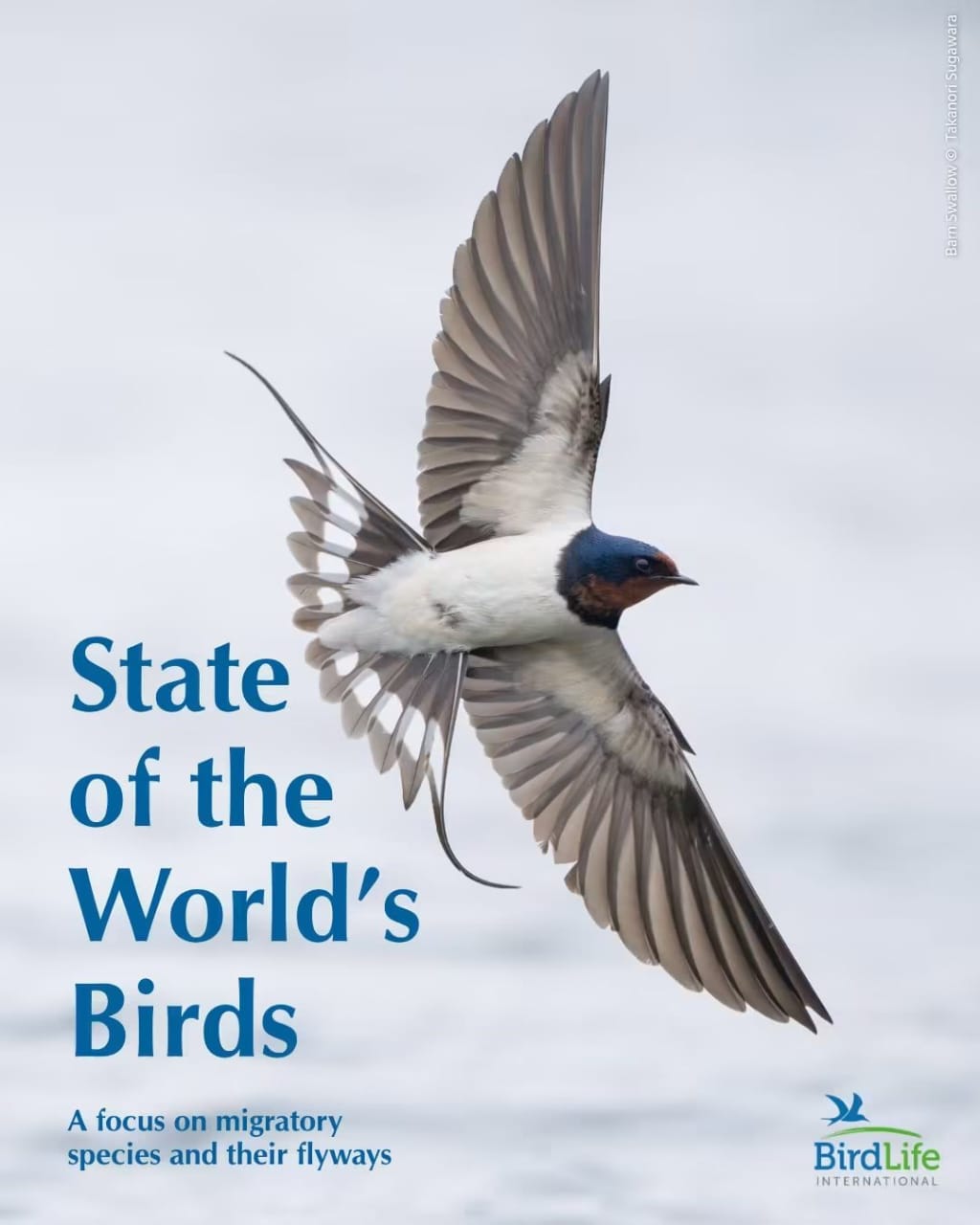

State of the World’s Birds 2026 Report: 45% of Migratory Bird Species Are in Decline.
BirdLife International has launched its new global report, State of the World’s Birds 2026, with this sixth edition focusing entirely on migratory birds and the flyways they depend on. The report examines the current status of migratory birds, the major threats they face, and the actions needed to protect the species and habitats on which they depend across continents.
The report comes at a time when pressures on migratory birds are increasing. Its findings indicate that:
🔴 45% of migratory bird species are experiencing population declines.
🔴 One in nine migratory bird species is threatened with extinction.
🔴 Seven migratory bird species have been confirmed or suspected to have gone extinct during the past 150 years. Among them is the Slender-billed Curlew (Numenius tenuirostris), which was officially declared extinct in 2025. Its last confirmed record was from a Moroccan lagoon in February 1995.
The report also reveals that shorebirds and seabirds are among the most threatened groups of migratory birds, while species dependent on marine habitats, forests, and coastal wetlands are experiencing particularly severe declines. BirdLife data indicate that 54% of migratory shorebird species are in decline, while 49% of migratory seabird species are experiencing population declines.
These declines are associated with a range of human-driven pressures, including habitat loss and degradation, agricultural expansion and intensification, hunting and unsustainable trapping, bycatch, invasive alien species, climate change, pollution, urban development, human disturbance, and poorly planned infrastructure.
The report emphasizes that a flyway is not simply a line on a map, but rather a broad, interconnected network of critical sites and habitats that migratory birds depend on throughout their annual cycle—from breeding grounds to migration stopover and refuelling sites, and ultimately to non-breeding areas. When one important link in this network is lost or degraded, the entire migratory system can be affected.
The report identifies four major terrestrial flyway systems: the Americas Flyway System, African-Eurasian Flyway System, Central Asian Flyway, and East Asian-Australasian Flyway, in addition to marine flyways connecting the world’s oceans and continents.
Consequently, the conservation of migratory birds cannot be achieved by protecting a single country or site in isolation. It requires international cooperation to protect, restore, and reconnect entire flyways, from breeding grounds through stopover sites to non-breeding areas.
Importantly, the report does not only document the scale of the crisis; it also presents numerous examples demonstrating that conservation can deliver measurable results when supported by effective management, adequate financing, scientific knowledge, and cooperation among governments, conservation organizations, and local communities.
Examples include successful habitat conservation initiatives, improved wetland management, support for local communities, and the development of modern monitoring programmes using satellite technology, tracking methods, and citizen science.
The report also highlights the importance of Key Biodiversity Areas (KBAs) and other important sites for birds, emphasizing the need to integrate these areas into national planning, protect and restore them, and maintain ecological connectivity across entire migratory flyways.
Perhaps the most important message of the report is that migratory birds are powerful indicators of ecosystem health. Their population declines do not represent the loss of birds alone; they can also signal the degradation of wetlands, forests, coastlines, marine ecosystems, and other natural systems upon which people also depend.
To read the full report and explore its findings, data, and recommendations in detail: https://datazone.birdlife.org/publications/state-of-the-worlds-birds-2026?fbclid=IwT01FWAUWVjtwZG9mAWV4dG4DYWVtAjEwAHNydGMGYXBwX2lkDDM1MDY4NTUzMTcyOAABHv9TyZIZLShDGo8Vf_WhjAQ5VhseJ-qo0zsNhLM2ZjdZaaYepWjv1fpsvuHg_aem_ICPf2taowRk_8-R90zhUFQ
Leave a Reply