




Clarification Regarding the Circulating Video of a Black Crowned Crane (Balearica pavonina) in Tripoli.
The Libyan Society for Birds (LSB) has received a video circulating on social media showing a Black Crowned Crane (Balearica pavonina), reportedly filmed in Tripoli.
We would like to provide some scientific context regarding this species and highlight its previous confirmed record in Libya.
First Record in Libya:
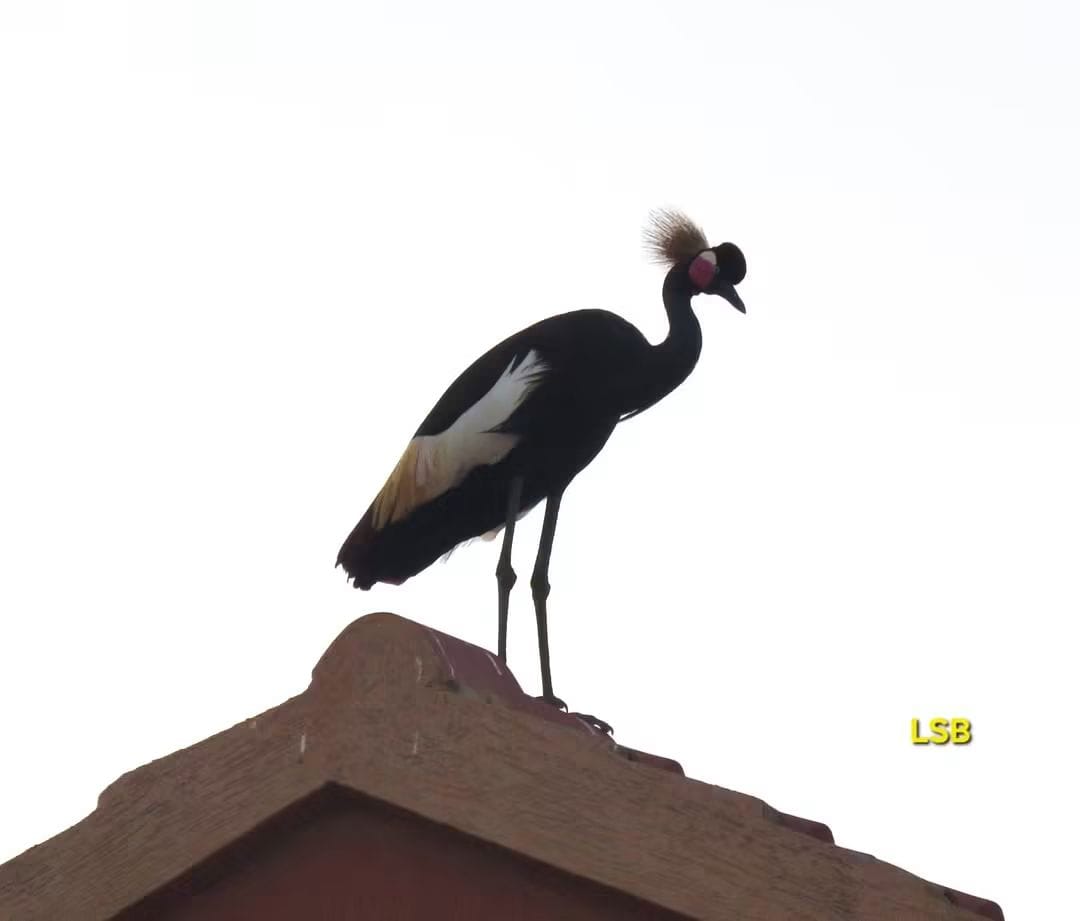
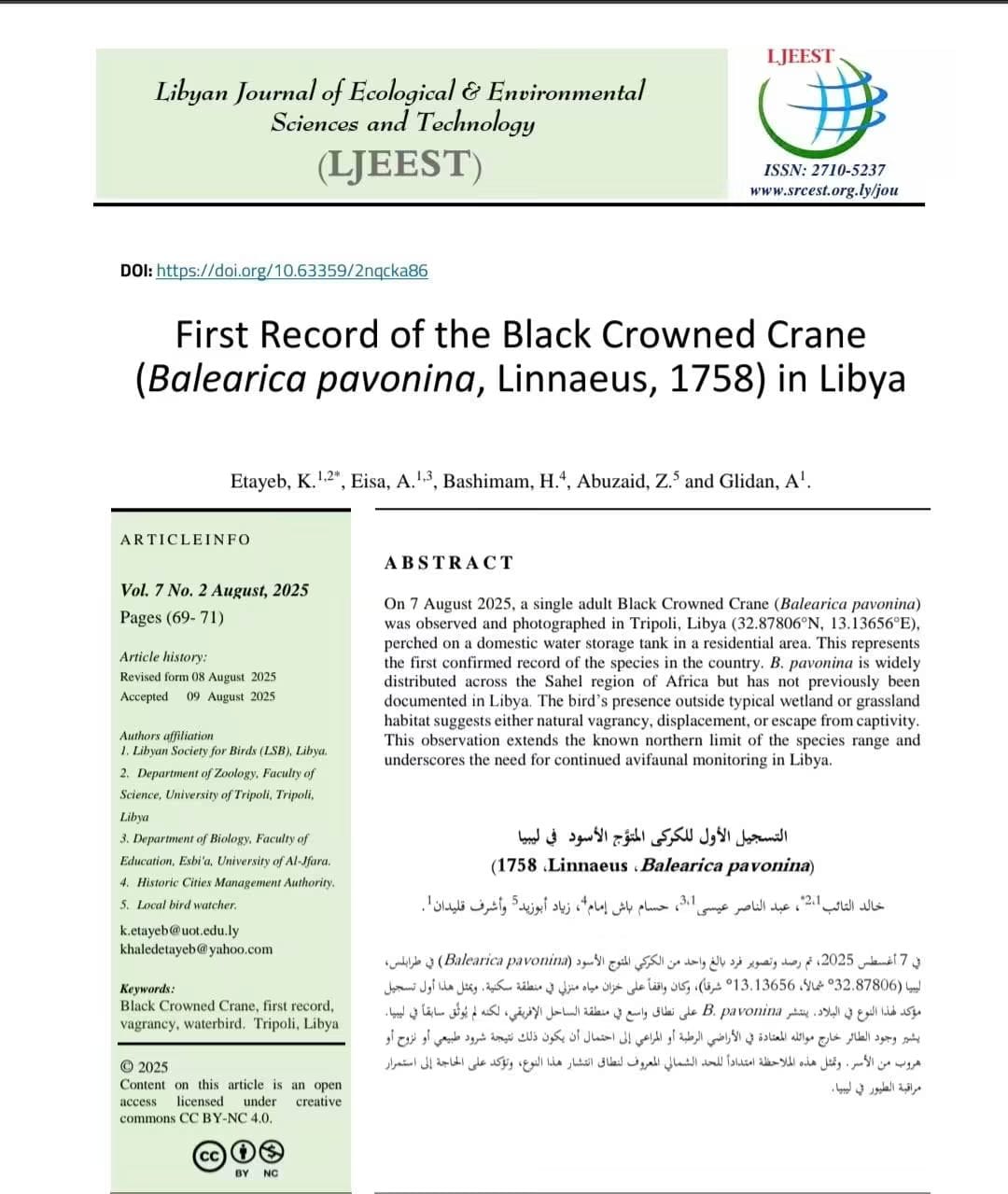
On 7 August 2025, a team from the Libyan Society for Birds, in cooperation with a local resident, observed and photographed an adult Black Crowned Crane in Tripoli. The bird was seen perched on a domestic water storage tank in a residential area. This observation represents the first confirmed record of the species in Libya and was subsequently published in the Libyan Journal of Ecological & Environmental Sciences and Technology (LJEEST), Volume 7, Issue 2, 2025.
Geographical Distribution:
The Black Crowned Crane is primarily distributed across the Sahel region of Africa, with its known range extending from Senegal and The Gambia in the west to Ethiopia and Sudan in the east. The species is associated with wetlands, floodplains, and grasslands.
Its occurrence in Libya, outside its usual geographical range, is therefore scientifically noteworthy. The 2025 record represented a northward extension of the species’ known range.
Possible Explanations:
Several possible explanations have been proposed for the species’ occurrence in Libya, including:
▪️ Natural vagrancy: The bird may have naturally wandered beyond its usual range as a result of dispersal or unusual movements.
▪️ Displacement: The bird may have been temporarily displaced by environmental, climatic, or habitat-related factors.
▪️ Escape from captivity: The possibility that the bird escaped from captivity cannot be excluded, particularly because Black Crowned Cranes are kept in some public and private collections.
However, the actual origin of the bird cannot be determined conclusively from the observation alone. Additional evidence would be required to support any of these hypotheses. The original scientific report likewise identified natural vagrancy, displacement, and escape from captivity as possible explanations.
The Libyan Society for Birds (LSB) emphasizes the importance of documenting rare bird sightings and sharing photographs, videos, locations, dates, and other relevant information. Such records have considerable scientific value for improving our understanding of bird movements, distribution, and the occurrence of rare species in Libya.
Leave a Reply