




Scientific Study Reveals the Migration of Eurasian Hobbies from Europe to Africa — Libya Lies Along Their Migration Route
A scientific study published in Bird Study in 2026 has provided detailed insights into the movements and migration of the Eurasian Hobby (Falco subbuteo), following two females fitted with GPS tracking devices. The research is among the relatively few studies to investigate this species’ movements during both the breeding season and migration.
The study, entitled “Movements on the breeding grounds and during migration of female Eurasian Hobbies Falco subbuteo tracked with GPS loggers,” aimed to improve understanding of the species’ movements by examining:
- Home-range size during the breeding season.
- Female movements around nesting sites.
- Autumn migration routes from Europe to Africa.
- Daily distances travelled during migration.
- Flight speeds and behaviour while crossing the Mediterranean Sea and the Sahara Desert.
Study methods
The research was conducted in 2021 in the Sokółka Upland of northeastern Poland. The researchers searched for Eurasian Hobby nests in July and successfully captured two adult females near their nests.
Each bird was fitted with a solar-powered GPS-GPRS tracking device weighing just five grams.
The devices recorded the birds’ locations every 10 minutes. When an onboard accelerometer detected flight activity, the devices activated a boost mode, recording a new location every minute. The two females were tracked for 77 and 80 days, respectively.
Key findings
Differences in movements during the breeding season
The results revealed substantial differences between the two females in their use of the areas surrounding their breeding sites.
Female #7663 was relatively sedentary, with most of her movements occurring within 1.5 km of the nest. She travelled beyond 5 km on only three occasions.
In contrast, female #7640 was considerably more mobile. She generally moved within a 5 km radius but made several longer trips of between 10 and 26 km towards the end of the breeding season.
Their home ranges differed markedly:
- Female #7663: 1.47 km².
- Female #7640: 83.21 km².
Daily travel distances during the breeding season also varied considerably:
- Female #7663: 22.9 km per day.
- Female #7640: 61.3 km per day.
Autumn migration from Poland to Africa
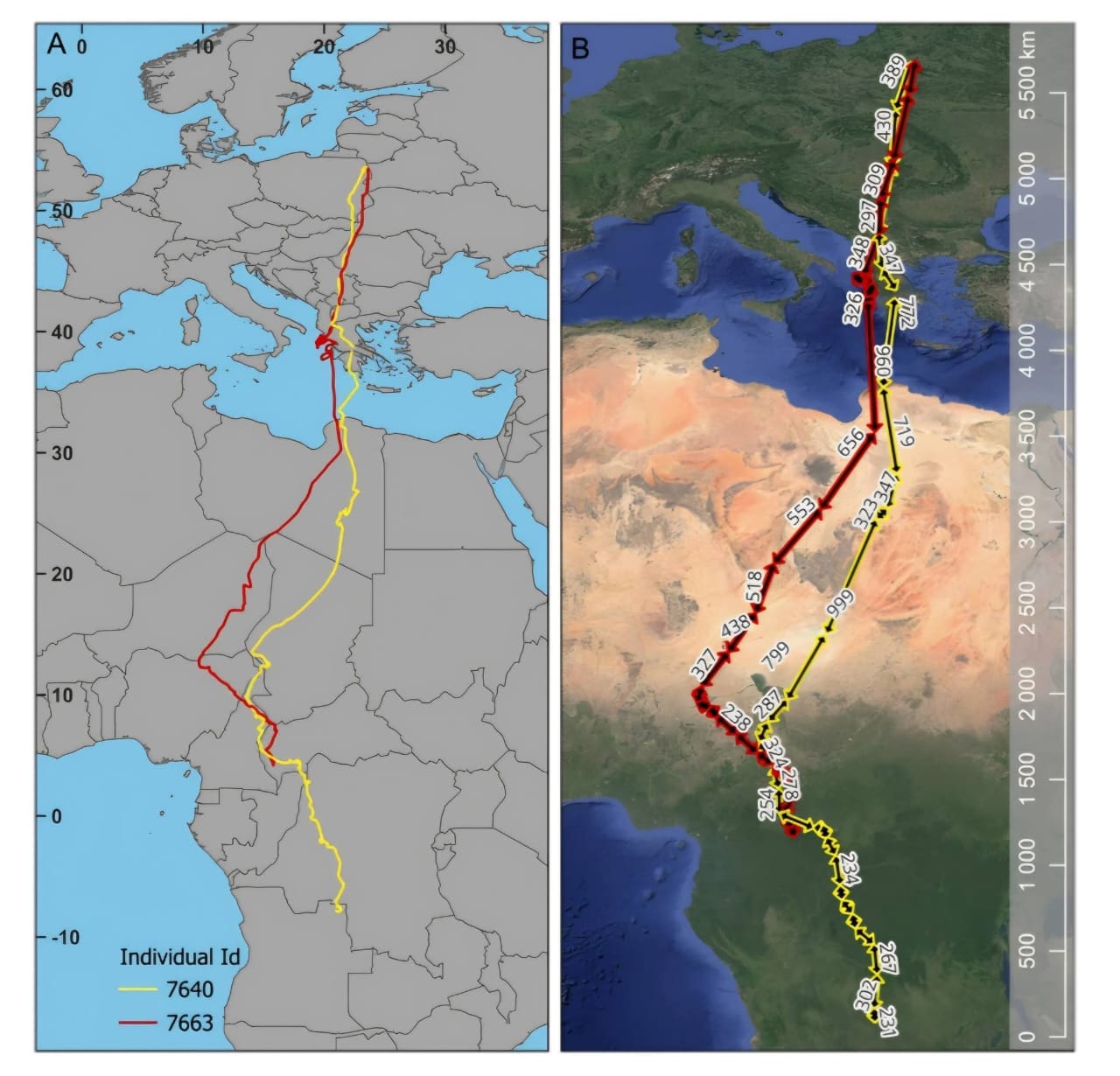
On 1 September 2021, both females began migrating south from their breeding grounds in Poland, travelling across Europe towards the Mediterranean Sea. However, their behaviour when approaching the sea differed substantially.
Female #7663: A delayed Mediterranean crossing
This female remained near the Greek coast for nine days. During this period, she made six attempts to travel 50–100 km southwest over the sea, returning each time.
On her seventh attempt, she departed at approximately 03:00 and crossed the Mediterranean directly southwards, reaching the African coast about 10 hours later.
She covered approximately 960 km that day, including the sea crossing and a further 350 km across the Sahara Desert.
Female #7640: A more direct crossing
The second female crossed the Mediterranean on her first attempt, travelling between approximately 09:50 and 15:30. She covered around 772 km before stopping after reaching the African coast.
Crossing the Sahara Desert and the Sahel
After entering Africa, both females crossed the Sahara Desert within four to five days.
During the desert crossing, their daily travel distances ranged from 323 to 999 km, with some flights continuing through the night.
Once they reached the Sahel, their daily travel distances decreased to approximately 124–324 km. Crossing this region took between three and five days, depending on the individual.
One female completed an exceptional journey, covering 999 km in one 24-hour period, followed by another 799 km in the next 24 hours. This amounted to nearly 1,800 km in just 48 hours.
The last recorded locations of the two females
Female #7663
She continued southwards to the Central African Republic, where the tracking device stopped transmitting on day 32 of migration, before she reached her presumed wintering area.
Female #7640
She migrated more rapidly, crossing the equator on day 24 and continuing southwards until reaching Angola on day 30. The researchers considered this a potential wintering area before the tracking signal was lost.
The tracking signals from both birds were eventually lost in central and southern Africa, after they had travelled approximately 10,000 km.
Why is this study important for Libya?
The migration map published with the study illustrates the routes taken by both females from Europe to Africa. Their routes extend southwards across the Mediterranean and through North Africa, crossing Libyan territory before continuing across the Sahara Desert.
This finding is particularly important for Libya because it is based on GPS tracking data from two individually identified birds, rather than solely on sightings or inferred distribution ranges.
The study provides further evidence of Libya’s role as a geographical corridor for migratory birds travelling between Europe and sub-Saharan Africa. It also demonstrates how GPS telemetry can reveal long-distance movements and migration behaviour that may be difficult to establish through field observations alone.
The Eurasian Hobby (Falco subbuteo) is recorded in Libya as a breeding migrant, making the documentation of its movements through the country particularly valuable for understanding its migration and seasonal movements.
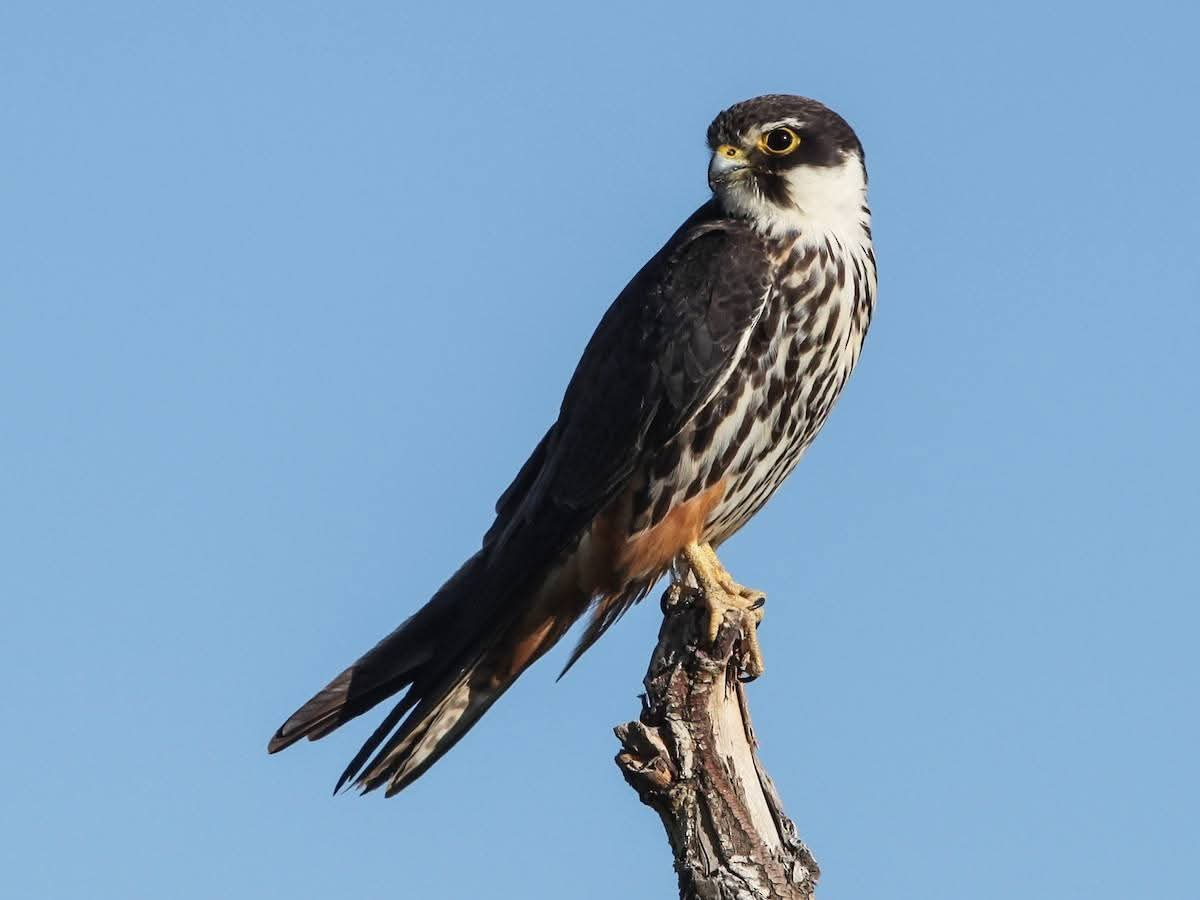
Bird photograph: eBird
Migration route map: Mirski et al. (2026)
Leave a Reply