





Scientific Study Reveals Converging Migration Routes of Eurasian Hobbies from Europe to Africa, with Libya Along the Migration Route
We previously highlighted a scientific study published in 2026 that investigated the movements of two female Eurasian Hobbies (Falco subbuteo) during the breeding and migration seasons using GPS tracking devices in Poland.
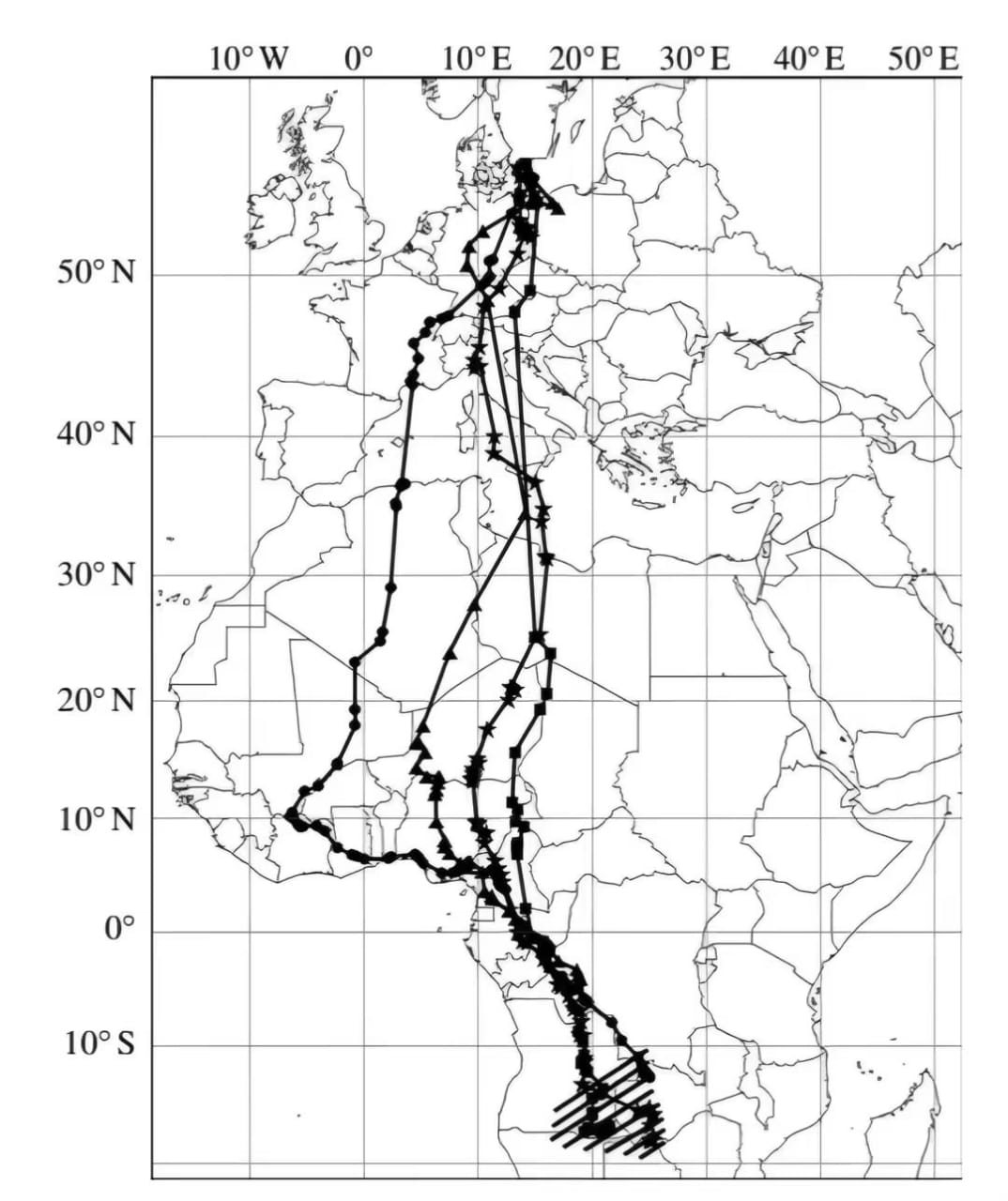
In a related study focusing on the same species, we turn to earlier research published in 2009 in Proceedings of the Royal Society B. The study examined the migration routes of four adult Eurasian Hobbies tracked by satellite from their breeding grounds in southern Sweden to their wintering areas in sub-Saharan Africa.
The paper was entitled “Converging migration routes of Eurasian hobbies Falco subbuteo crossing the African equatorial rain forest.”
The researchers aimed to investigate autumn migration routes and determine whether the convergence of birds travelling towards Africa occurred by chance or was associated with geographical and environmental factors influencing route selection.
Between 2005 and 2007, researchers captured four adult Eurasian Hobbies in southern Sweden—three females and one male—and fitted them with solar-powered satellite transmitters.
A total of 786 geographical locations were collected during autumn migration. The researchers compared the birds’ actual routes with simulated random routes to investigate movement patterns and the degree of convergence between individuals.
Migration from Europe to Africa
Tracking data showed that the birds initially travelled southwards and southwestwards across Europe before crossing the Mediterranean Sea and the Sahara Desert. They subsequently changed direction towards the southeast in western Africa.
Three of the four birds crossed the Mediterranean from Italy or Sicily into Libya, while the fourth followed a route through France into Algeria.
One of the study’s most striking findings was that the migration routes, which were separated by more than 2,000 km at latitude 10°N, converged considerably closer to the equator, in an area within the Republic of the Congo.
Analysis revealed that all four birds passed within 70 km of one another, despite being tracked in different years over a three-year period.
Statistical comparisons further indicated that this degree of convergence was inconsistent with the pattern expected if the migration routes had been selected randomly.
The influence of Central African rainforests
The researchers proposed that the continuous tropical rainforests of Central Africa may act as an ecological barrier to migrating birds, owing to conditions that could be unfavourable for flight and foraging in certain areas.
Travelling through a less densely forested region could reduce the distance spent crossing tropical rainforest to approximately 450–600 km. This may help explain why the birds’ routes converged towards a relatively narrow corridor near the equator.
However, the authors acknowledged that the study involved a limited number of birds, meaning that the findings alone could not establish whether the same pattern applies to all migratory bird species.
Why is this study important for Libya?
This study is particularly relevant to Libya because satellite-tracking data documented three individual Eurasian Hobbies crossing Libyan territory during their autumn migration from Europe to Africa.
The findings highlight Libya’s geographical importance along migratory routes connecting the two continents and demonstrate the scientific value of satellite tracking in revealing migration pathways that may not be detected through field observations alone.
This earlier research also complements the 2026 study we previously discussed on the movements of female Eurasian Hobbies during breeding and migration. While the more recent study focused on movements around breeding sites and the details of Mediterranean and desert crossings, the 2009 research investigated the convergence of migration routes and its possible relationship with the distribution of African rainforests.
📷 Bird photograph: eBird
🗺️ Migration route map: Strandberg et al. (2009), Proceedings of the Royal Society B.
Leave a Reply