





Scientific Study Reveals Migration Routes of the European Roller and Highlights Libya’s Role Along the Europe–Africa Migration Flyway
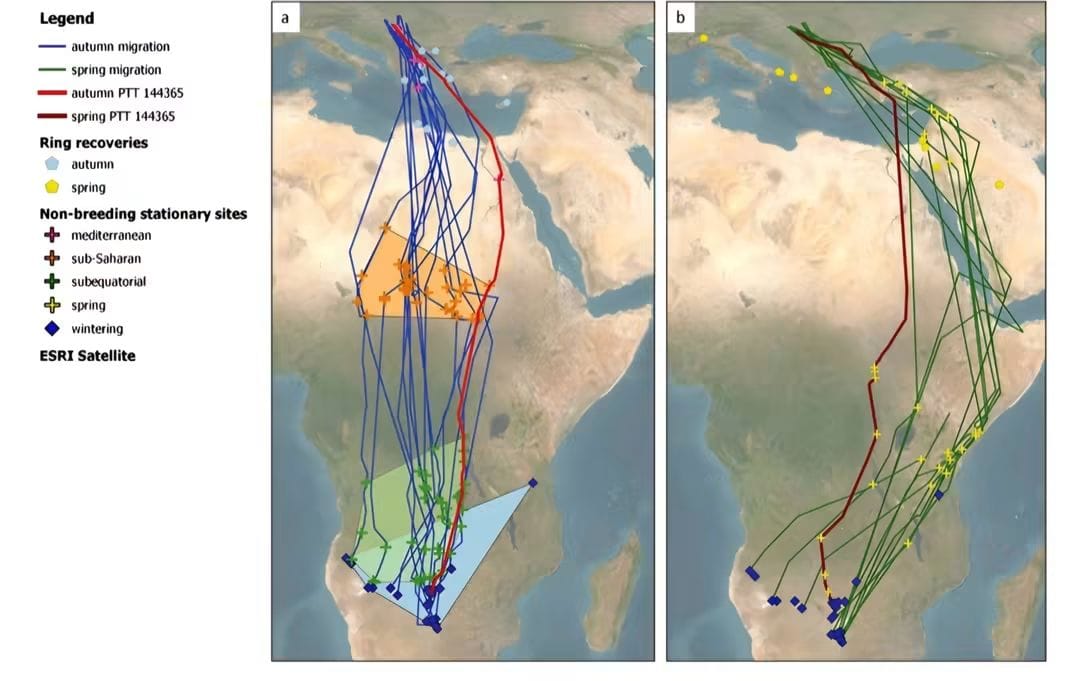
A scientific study published in 2026 in the journal Movement Ecology, titled “The global importance of grasslands underlined by the combination of multiple telemetry tracking techniques of a trans-equatorial loop migrant bird, the European roller (Coracias garrulus)”, provides new insights into the seasonal migration patterns, movement routes, stopover sites, and wintering areas of the European Roller (Coracias garrulus), a long-distance migratory bird that travels between Europe and Africa.
The study investigated European Rollers breeding in Hungary and Romania, within the Carpathian Basin, using several modern tracking techniques, including GPS-UHF tags, PTT satellite transmitters, and geolocators. These technologies allowed researchers to track the birds throughout their annual cycle and identify important stopover sites and habitats used during migration and the non-breeding period.
Key findings:
🔹 Multiple migration routes:
The study revealed that European Rollers use multiple migration routes, with their wintering distribution extending widely from east to west across southern Africa.
🔹 Stopover sites:
Researchers identified 108 stopover sites during the non-breeding period, including 77 sites during autumn migration and 31 during spring migration.
🔹 Importance of the sub-Saharan region:
Two major areas were identified as important stopover regions during autumn migration: the sub-Saharan region and the subtropical region. The birds spent a longer period in the sub-Saharan region.
🔹 Wintering areas:
Wintering areas extended across large parts of the southern African savanna zone, including Angola, Namibia, Botswana, Zambia, and Tanzania.
🔹 Importance of grasslands:
The study highlighted the important role of grassland habitats in providing suitable environments for European Rollers during the breeding season, migration, and wintering period.
Libya’s importance along the migration route:
The migration maps presented in the study indicate that Libya lies along the autumn migration route of some tracked individuals, with birds crossing Libyan territory as they travel from their European breeding grounds toward their sub-Saharan African wintering areas.
The maps also show stopover locations during autumn migration in parts of Libya, highlighting the potential importance of the country as a passage and stopover area for migratory birds. Some of Libya’s natural habitats may provide important feeding and resting opportunities for birds during their autumn journey.
These findings further emphasize the importance of strengthening migratory bird monitoring programmes in Libya, documenting passage and stopover sites, and studying the natural habitats used by migratory species throughout their seasonal movements.
It is worth noting that the European Roller is recorded in Libya as a passage migrant, passing through the country during migration without breeding or remaining there for the winter
Leave a Reply