

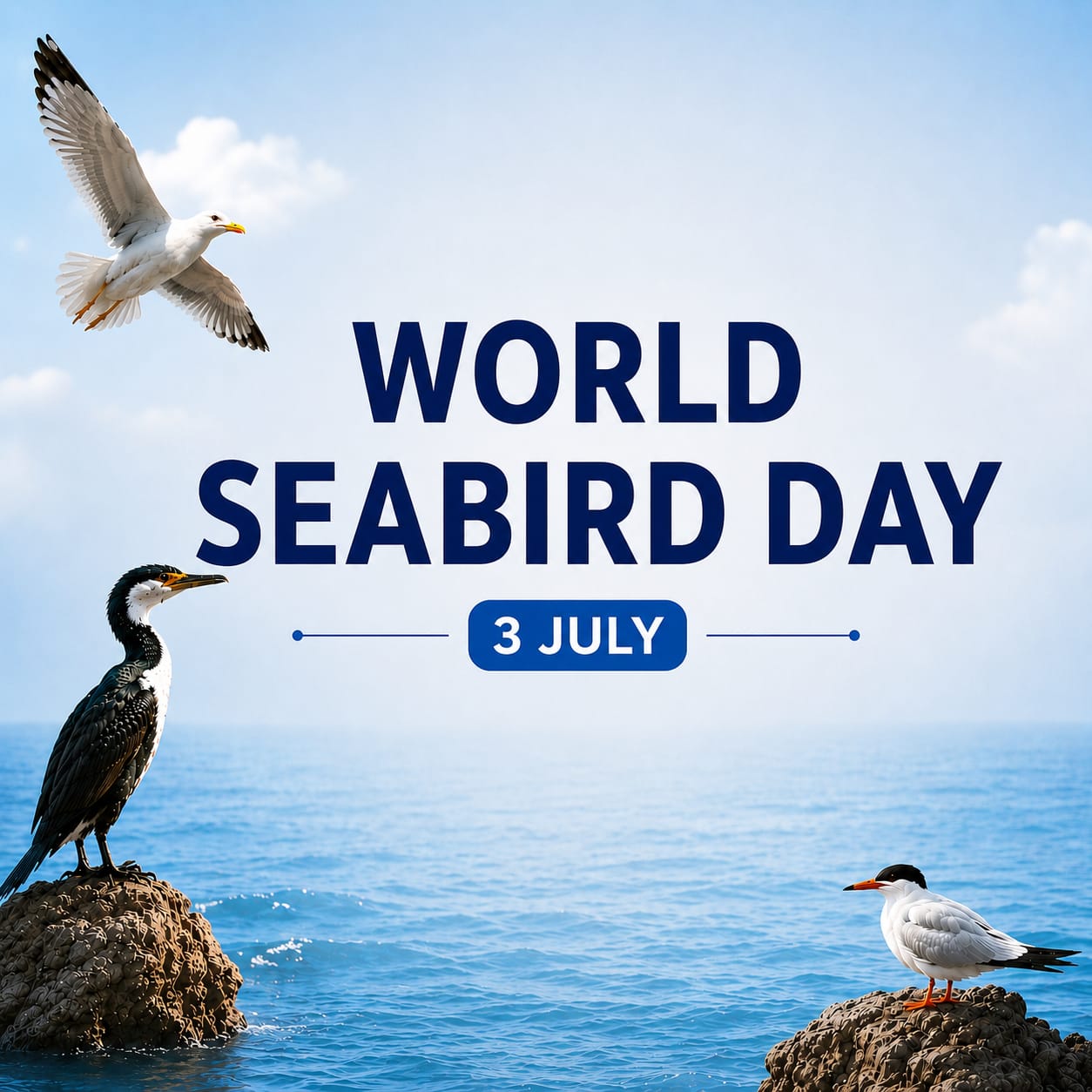

World Seabird Day – 3 July.
Every year on 3 July, the world marks World Seabird Day, an occasion dedicated to raising awareness of the importance of seabirds and the urgent need for their conservation. The date also commemorates the last confirmed sighting of the extinct Great Auk (Pinguinus impennis) in 1844.
● What are seabirds?
Seabirds are a group of birds adapted to life in marine environments, spending a significant part or most of their lives at sea. They depend on oceans and seas for feeding, breeding, and migration. This diverse group includes gulls, terns, cormorants, gannets, skuas, and others.
Seabirds play an important ecological role. They are considered valuable biological indicators of marine ecosystem health and contribute to maintaining the natural balance of seas and oceans.
● Threats facing seabirds:
Seabirds are among the most threatened groups of birds worldwide. Major threats include:
- Loss and degradation of nesting and feeding habitats.
- Marine pollution, particularly plastic pollution and oil spills.
- Accidental entanglement and bycatch in fishing nets and fishing lines.
- Climate change and rising sea temperatures.
- Predation at nesting sites.
- Diseases, including avian influenza.
● Seabirds in Libya:
A total of 36 seabird species have been recorded in Libya, highlighting the ecological importance of Libya’s coastline and islands for seabirds in the Mediterranean.
According to their ecological status in Libya, these species comprise:
- 17 winter visitors.
- 8 vagrants.
- 5 breeding migrants.
- 4 passage migrants.
- 2 breeding residents.
In terms of their global conservation status according to the IUCN Red List, the recorded seabird species include:
- 32 species classified as Least Concern (LC).
- 3 species classified as Vulnerable (VU).
- 1 species classified as Critically Endangered (CR).
Among the globally threatened seabird species recorded in Libya are:
- Balearic Shearwater (Puffinus mauretanicus) – Critically Endangered (CR).
- Yelkouan Shearwater (Puffinus yelkouan) – Vulnerable (VU).
- Black-legged Kittiwake (Rissa tridactyla) – Vulnerable (VU).
- Audouin’s Gull (Ichthyaetus audouinii) – Vulnerable (VU).
On this occasion, the Libyan Society for Birds (LSB) emphasises the importance of protecting seabirds and their natural habitats, strengthening national efforts to monitor and conserve their populations, and reducing marine pollution, habitat destruction, and other human activities that threaten their survival.
Leave a Reply