





Across Libya and the Sahara to the Heart of the Congo: An Extraordinary 7,000-Kilometre Migration Journey by an Osprey.
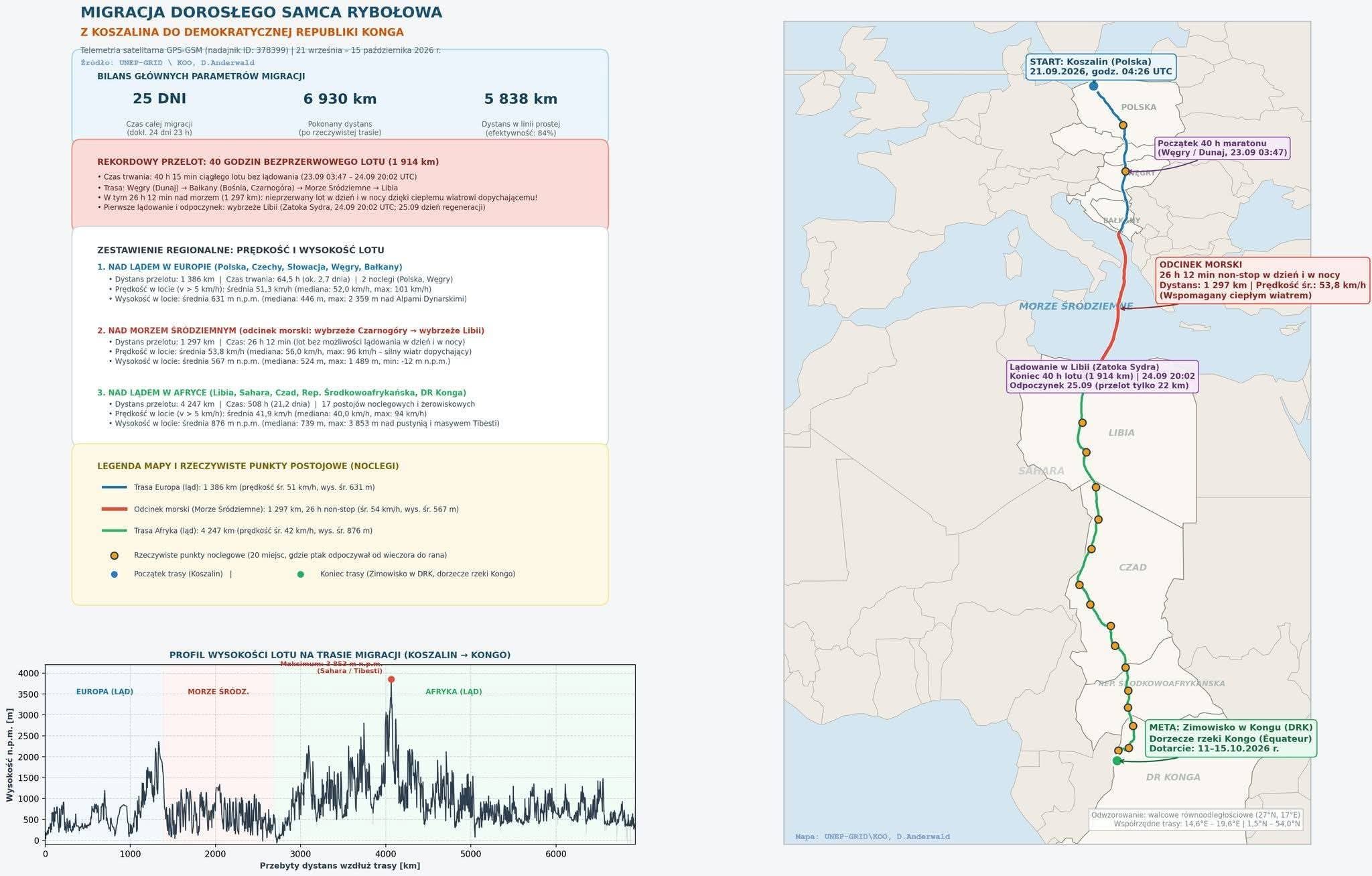
Satellite tracking data have revealed an extraordinary migration journey undertaken by an adult male Osprey (Pandion haliaetus), which travelled from the city of Koszalin in Poland to its wintering grounds in the Democratic Republic of the Congo, covering approximately 6,930 kilometres in just 25 days, according to the tracking map and data published by the organisation monitoring the bird.
This remarkable journey demonstrates the impressive navigational abilities of migratory birds and highlights the importance of North Africa and the Sahara Desert in connecting European breeding grounds with wintering areas in sub-Saharan Africa.
The journey began on 21 September 2026, when the bird departed from Koszalin in northwestern Poland. It then headed south through several European countries, reaching the Danube River region in Hungary, where the longest continuous flight of its migration began.
According to the tracking data, the Osprey covered 1,914 kilometres in approximately 40 hours and 15 minutes of uninterrupted flight before reaching the coast of the Gulf of Sirte in Libya on 24 September, where it stopped to rest and recover.
The bird subsequently crossed the Mediterranean Sea in a flight lasting approximately 26 hours and 12 minutes, covering a distance of 1,297 kilometres while benefiting from favourable atmospheric conditions.
Libya and the Sahara Desert formed an important part of the African leg of this migration. After reaching Libya, the bird continued southwards across desert landscapes towards Chad, then the Central African Republic, before finally reaching the Democratic Republic of the Congo.
The published data indicate that the bird travelled approximately 4,247 kilometres across African territory, representing more than 60% of its total journey.
While crossing the Sahara, the tracking device recorded an altitude of approximately 3,850 metres above sea level in the desert region and the Tibesti mountain massif. This observation highlights the importance of investigating the relationship between topography, atmospheric conditions and flight behaviour in migratory birds.
The recorded locations also indicate that the bird relied on overnight stopovers during its overland journey, allowing it to rest and resume migration under suitable conditions.
After crossing the Central African Republic, the bird reached Équateur Province in the northwestern part of the Democratic Republic of the Congo, within the Congo River Basin, during the period from 11 to 15 October 2026.
The riverine habitats and wetlands of the Congo Basin are important environments for numerous bird species. As an almost exclusively fish-eating bird, the Osprey depends heavily on healthy aquatic habitats and sufficient prey availability, making these areas particularly important for its feeding and wintering activities.
This remarkable journey demonstrates the scientific value of satellite tracking in studying bird migration. It enables researchers to identify geographical routes, measure travel distances and flight durations, and document stopover sites and wintering areas.
It also highlights the importance of protecting stopover sites and aquatic habitats along migratory routes, rather than focusing conservation efforts exclusively on breeding and wintering grounds.
For Libya, documenting the movements of migratory raptors across its territory further emphasises the importance of continuing bird monitoring programmes, exchanging scientific data and identifying areas that provide essential opportunities for resting and feeding during long-distance migrations.
Source: Polish Eagle Conservation Committee (Komitet Ochrony Orłów – KOO).
Leave a Reply